Squeeze3D:
Extreme Neural Compression with Latent Space Bridging

University of Toronto  ·  Vector Institute

How can we bridge the latent spaces of different models? We do so with losses in the latent space, no reconstruction-based losses. As an application, we apply this to 3D and show we can use it for extreme compression.

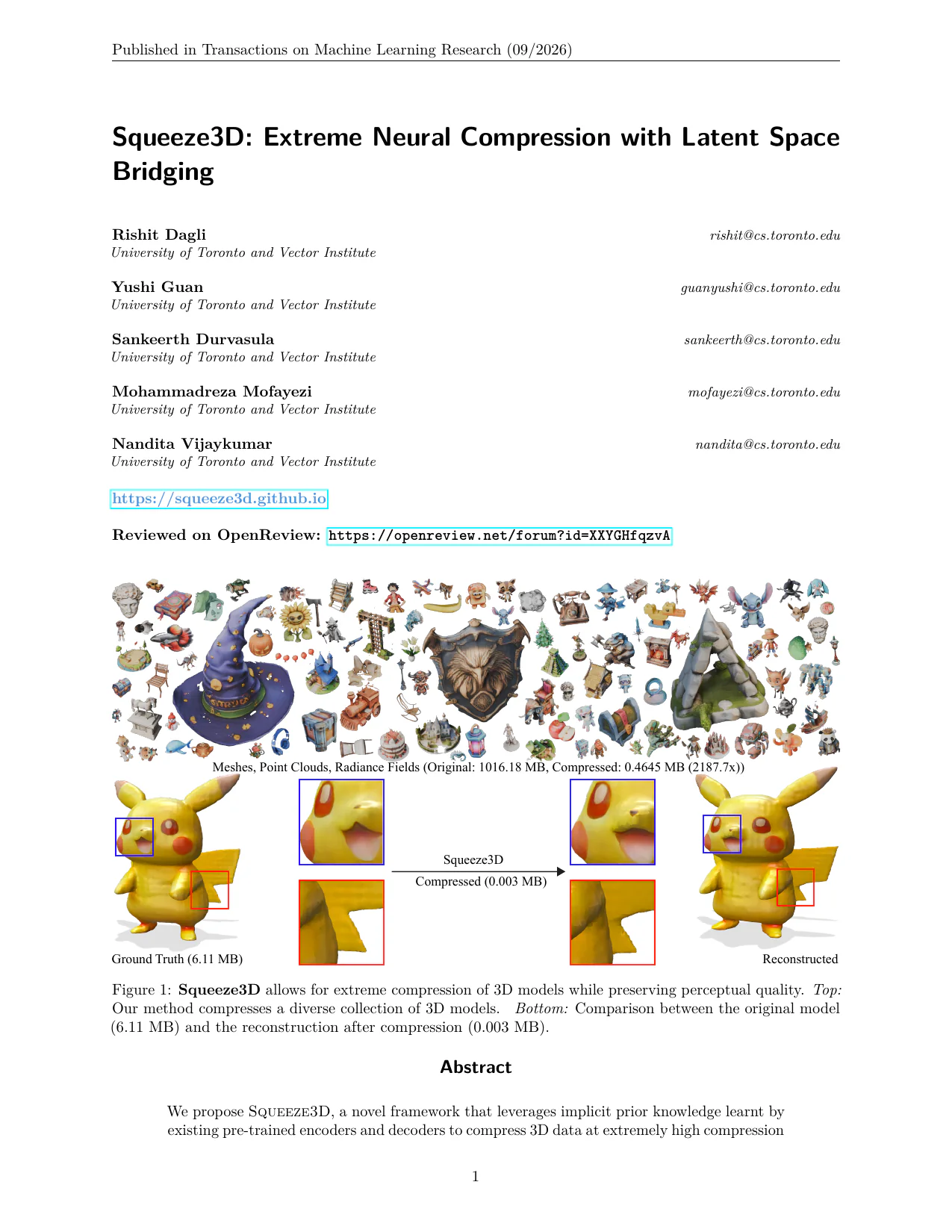
Squeeze3D teaser
Squeeze3D allows for extreme compression of 3D models while preserving perceptual quality. Top: Our method compresses a diverse collection of 3D models. Bottom: Comparison between the original model (6.11 MB) and the reconstruction after compression (0.003 MB).

Abstract

We propose Squeeze3D, a novel framework that leverages implicit prior knowledge learnt by existing pre-trained encoders and decoders to compress 3D data at extremely high compression ratios. Our approach bridges the latent spaces between a pre-trained encoder and a pre-trained decoder model through trainable mapping networks. Any 3D asset represented as a mesh, point cloud, or radiance field is first encoded by the pre-trained encoder and then transformed (i.e. compressed) into a highly compact latent code by a mapping network. This latent code can effectively be used as an extremely compressed representation of the mesh, point cloud, or radiance field. A mapping network transforms the compressed latent code into the latent space of a powerful generative model; the decoder of this generative model then recreates the original 3D asset (i.e. decompression). Squeeze3D is trained entirely on generated synthetic data and does not require any 3D datasets. The Squeeze3D architecture can be flexibly used with existing pre-trained 3D encoders and existing generative models. It can flexibly support different formats, including meshes, point clouds, and radiance fields. Our experiments demonstrate that Squeeze3D achieves compression ratios of up to 2187× for textured meshes, 58.5× for point clouds, and more than 650× for radiance fields while maintaining visual quality comparable to many existing methods. Squeeze3D only incurs a small compression and decompression latency since it does not involve training object-specific networks to compress an object.

🚀Key Contributions

🎯 To the best of our knowledge, this is the first framework that leverages pre-existing, pre-trained generative-model decoders to enable extreme compression of 3D data.

🔗 We demonstrate the feasibility of aligning latent spaces from networks with different structures, objectives, and training distributions. A Gram loss prevents collapse onto a few dominant directions, while synthetic data trains each mapping pair without requiring a 3D dataset.

📊 We evaluate Squeeze3D for mesh, point cloud, and radiance field compression and demonstrate that generative models are a promising approach for extreme compression of 3D models. Squeeze3D can be flexibly extended to different encoders, generative models, and 3D formats.
Squeeze3D

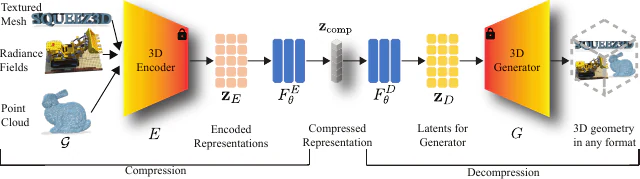
Squeeze3D achieves extreme compression by bridging the latent spaces of pre-trained 3D encoders and generators through trainable mapping networks. Rather than training specialized compression models for each object, we leverage the implicit knowledge already learned by existing 3D generative models. The pre-trained encoder and decoder remain frozen; only the mapping networks are trained.

Squeeze3D pipeline
Overview of our Method. Squeeze3D bridges arbitrary latent spaces between 3D encoders and generators through trainable mapping networks. During compression, a 3D geometry is encoded and then transformed into a compact representation via the forward mapping network. During decompression, the reverse mapping network converts this representation into the generator's latent space, which is then used to reconstruct the original geometry.

Key Components

The architecture consists of four main components:

  • Pre-trained 3D Encoder (E): Converts 3D geometries into latent representations zE
  • Forward Mapping Network (FEθ): Transforms encoder latents into compressed representation zcomp
  • Reverse Mapping Network (FDθ): Maps compressed representation to generator latent space zG
  • Pre-trained generative-model decoder (G): Reconstructs 3D geometry from latent codes

Training Process

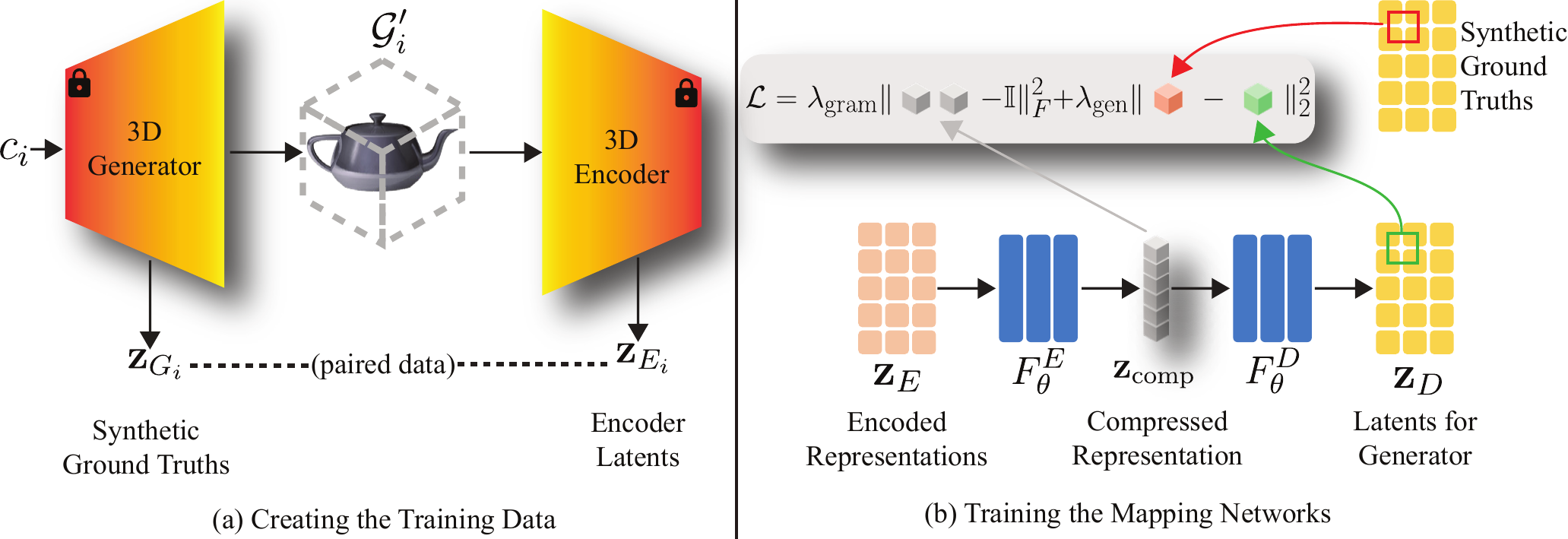
Since we cannot directly obtain paired data between encoder and generator latent spaces, we employ a synthetic data generation approach:

Training process
Training Squeeze3D. We show an overview of (a) our process of creating synthetic data to train the mapping networks and (b) our process of training the mapping networks.
  • Gram Loss: Standard latent-space MSE concentrates information along a few dominant directions. Our Gram loss encourages a semi-orthogonal compressed representation so the available latent dimensions are used effectively.
  • Flexible Formats: The same framework supports meshes, point clouds, and radiance fields by pairing suitable existing encoders and generative-model decoders; the mapping networks are trained once for each encoder–decoder pair and compressed dimension.

After one-time training for an encoder–decoder pair, each object is compressed and decompressed with feed-forward inference and no per-object optimization.

Main Results


Comparison with Previous Works

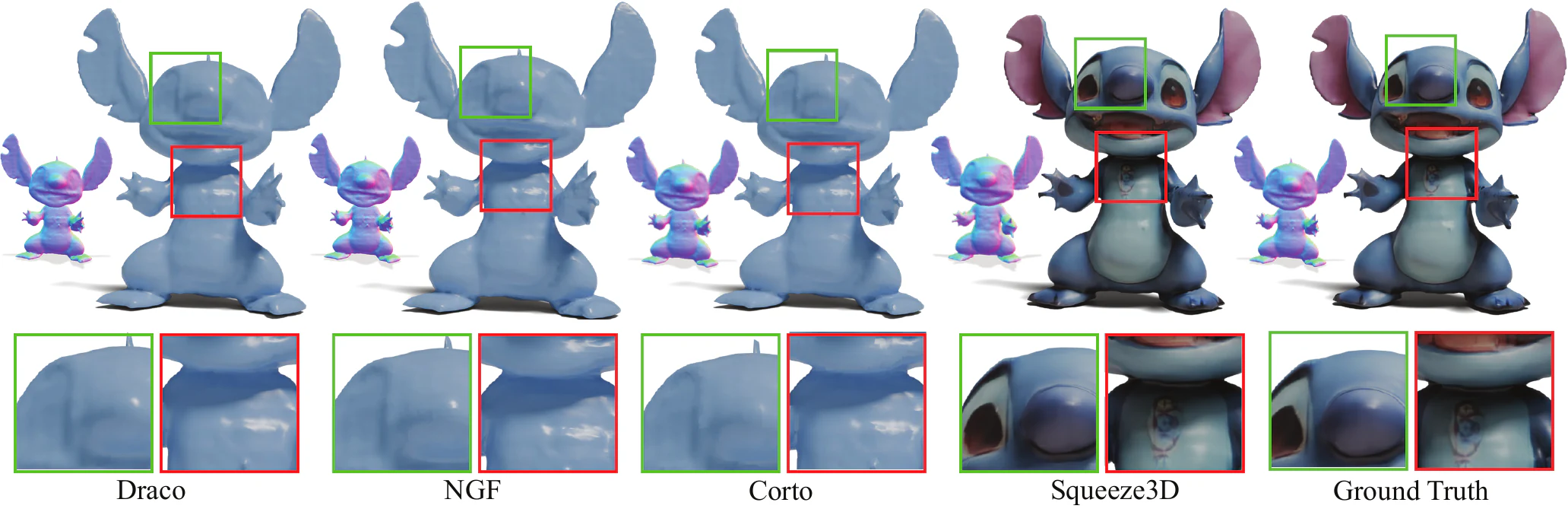
Mesh compression comparison
Qualitative mesh compression results. We compare Squeeze3D with established mesh-compression methods. Our approach maintains visually important geometric details.
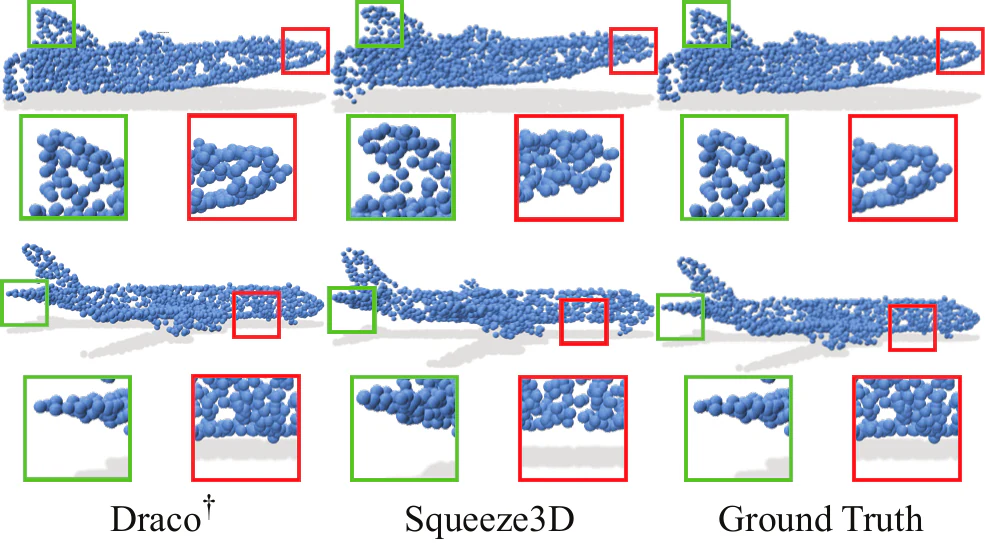
Point cloud compression comparison
Qualitative point-cloud compression. Reconstructions from Squeeze3D and established codecs. The displayed Draco result uses a much higher-storage operating point.
Radiance field compression comparison
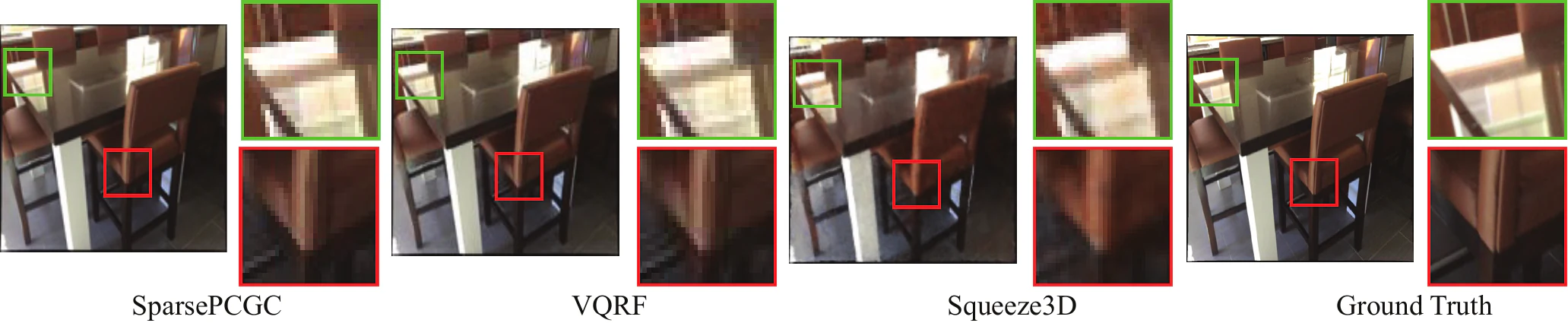
Qualitative radiance-field compression results. We compare Squeeze3D with established methods while preserving visually important scene details.

Compression at a Glance

2187×

Meshes

6.43 MB → 3.01 KB

58.5×

Point clouds

117 KB → 2.00 KB

619×

Radiance fields

58.07 MB → 0.09 MB

Mesh Results

Drag the divider to compare each ground-truth mesh with its Squeeze3D reconstruction. Drag the model to rotate it and scroll to zoom.

Radiance Field Results

Compare ground-truth radiance fields (left) with Squeeze3D reconstructions (right). These examples are randomly selected from the test set and shown from one fixed view. Drag the slider to inspect each result.

Point Cloud Results

Drag the divider to compare each ground-truth point cloud with its Squeeze3D reconstruction. Drag the point cloud to rotate it and scroll to zoom.

Additional Results and Analysis


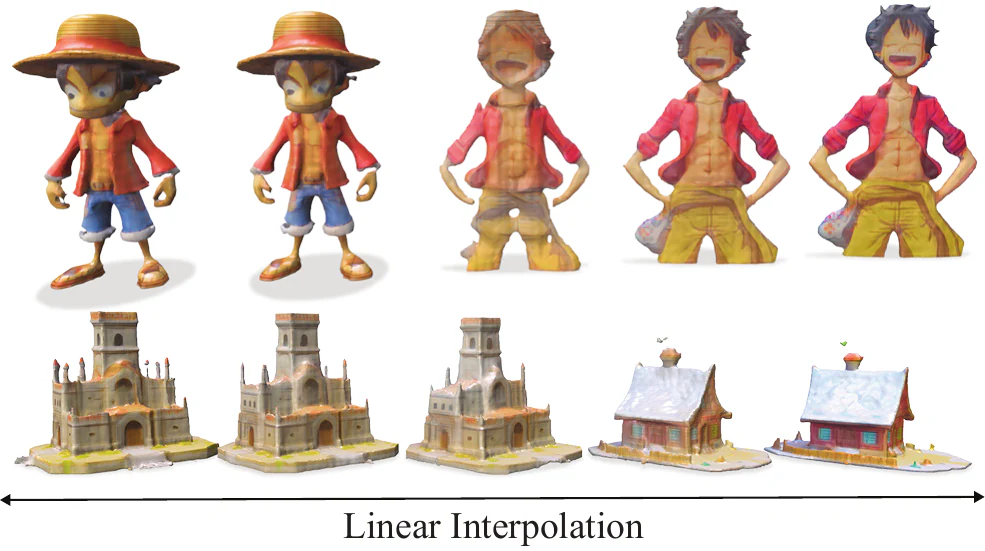
Interpolation results
Interpolation. The compressed representations we obtain can also be interpolated. In these examples, we obtain the compressed representation for the leftmost and rightmost meshes and linearly interpolate between them.
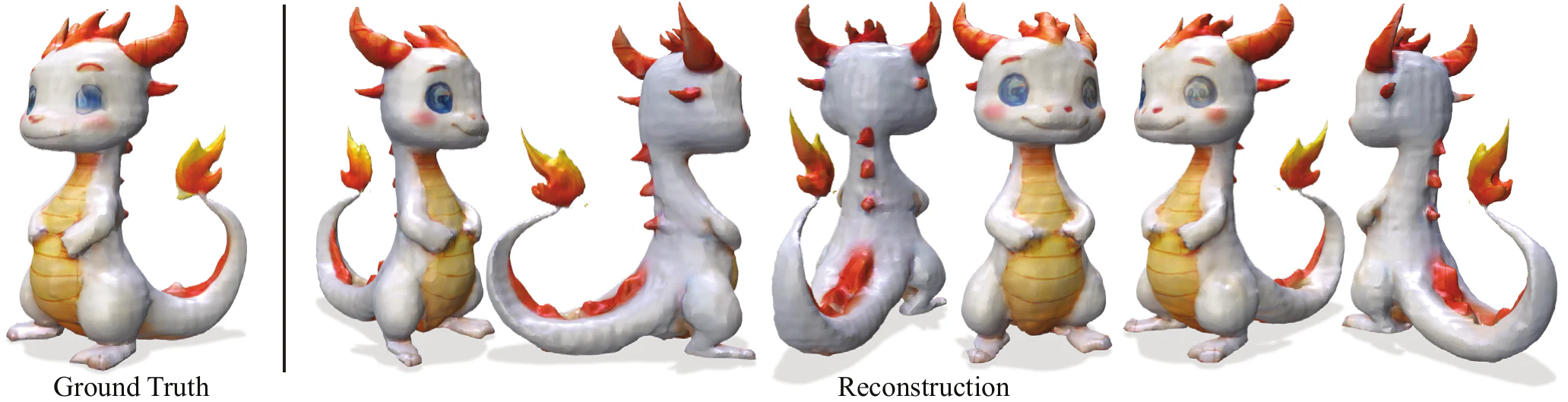
Multiple camera angles
Multi-view visualization of compressed and reconstructed meshes. The consistent appearance across viewing angles shows that Squeeze3D produces coherent 3D reconstructions rather than view-dependent features.
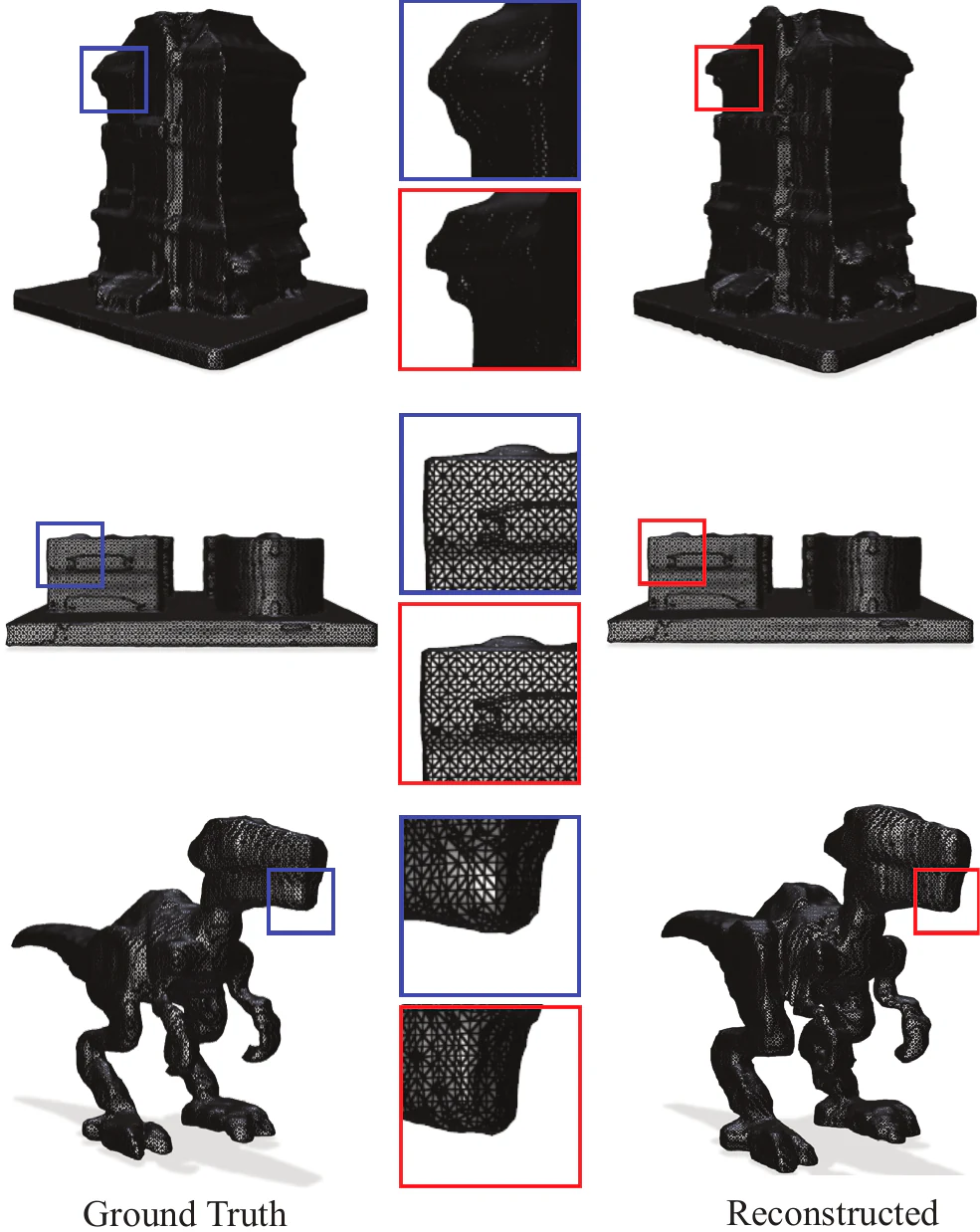
Textureless mesh compression
Squeeze3D preserves geometry details. Wireframe views show that the reconstructions retain many fine-grained geometric details.
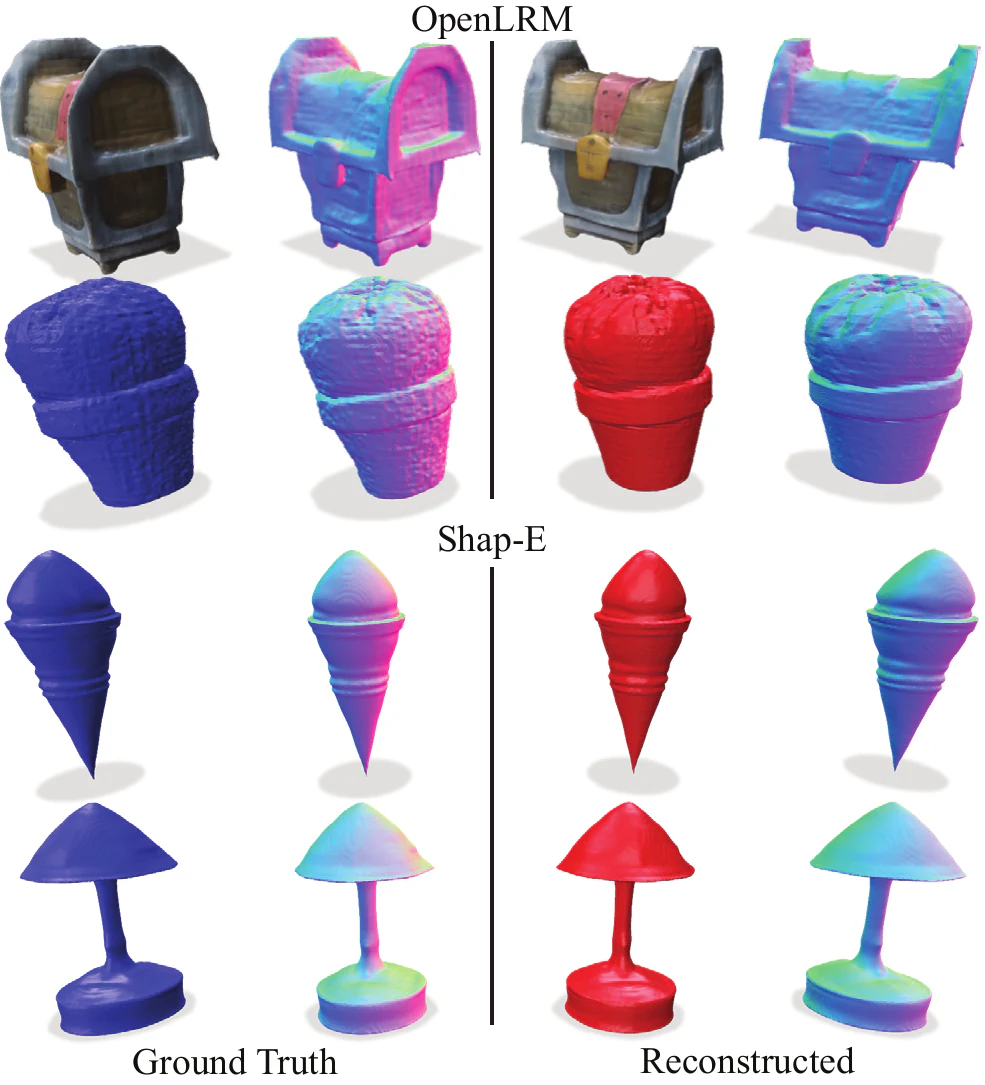
Different 3D generators
Compression results using different 3D generators. Squeeze3D is agnostic to the choice of a 3D generation model. We show results with OpenLRM and Shap-E on meshes within the representational capacity of each generator.
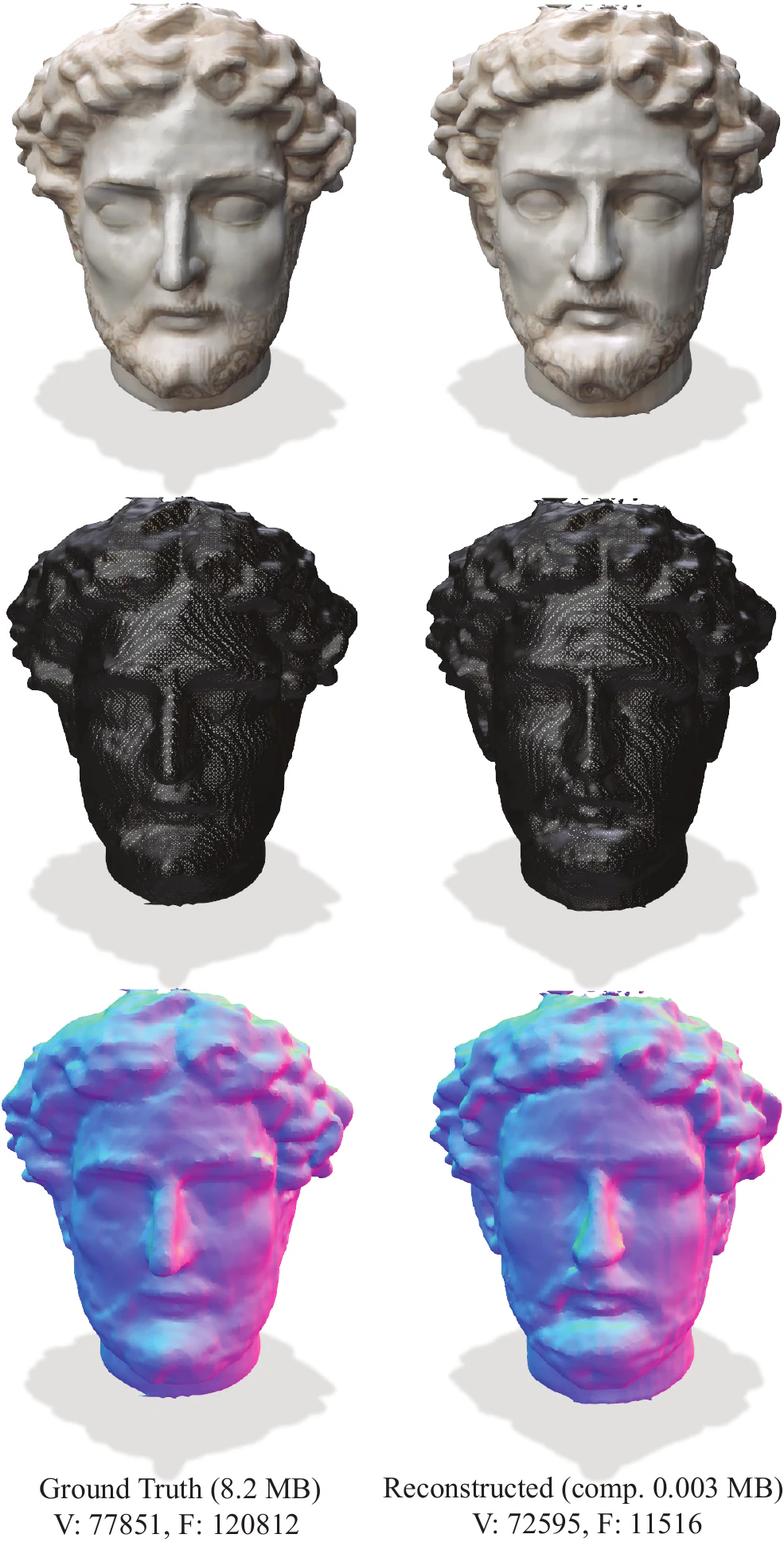
Complex mesh compression
Compressing Complex Meshes. Squeeze3D can be used to compress highly complex textured 3D meshes (in this case 77851 vertices and 120812 faces).

Paper

Paper thumbnail

Squeeze3D: Extreme Neural Compression with Latent Space Bridging

Rishit Dagli, Yushi Guan, Sankeerth Durvasula, Mohammadreza Mofayezi, Nandita Vijaykumar

University of Toronto · Vector Institute

BibTeX

@article{dagli2026squeeze3d,
title={Squeeze3D: Extreme Neural Compression with Latent Space Bridging},
author={Rishit Dagli and Yushi Guan and Sankeerth Durvasula and Mohammadreza Mofayezi and Nandita Vijaykumar},
journal={Transactions on Machine Learning Research},
issn={2835-8856},
year={2026},
url={https://openreview.net/forum?id=XXYGHfqzvA}
}